New toolkit helps local actors understand and strengthen the ripple effects of sustainability action

How does local action contribute to wider societal change? How can community initiatives, civil society organisations and local authorities better understand the impact they have beyond their immediate activities?
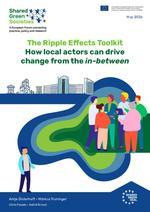
These questions are at the heart of a new resource developed by partners in the SHARED GREEN DEAL project. The Ripple Effects Toolkit: How local actors can drive change from the in-between provides practical guidance for anyone working to support sustainability transitions, helping users identify and strengthen the connections between people, organisations and systems that enable lasting change.
Led by researchers from the Institute of Social Sciences of the University of Lisbon (ICS-ULisboa) with contributions from Anglia Ruskin University and TU Wien, the toolkit translates academic research on the ‘in-between’ spaces where local action connects individuals and wider systems into a set of practical exercises that can be used by practitioners, community groups, municipalities and researchers.
The toolkit is also the result of a highly collaborative development process. During March and April 2026, the authors organised a series of online workshops in five languages to test and refine the toolkit's concepts and exercises. A total of 123 participants from 17 countries took part, sharing experiences, feedback and reflections that helped shape the final resource.
This collaborative approach reflects one of the toolkit's central messages: meaningful change rarely happens in isolation. Instead, it emerges through relationships, shared learning and collective action. Participants highlighted the importance of recognising and giving visibility to the often-overlooked work taking place between individuals and institutions, helping strengthen the case for community-led approaches to sustainability transitions.
The toolkit introduces the concept of the ‘in-between’ and guides users through a series of practical exercises designed to map initiatives, explore connections and identify potential ripple effects. By doing so, it helps users better understand how local activities can influence wider practices, organisations and systems over time.
The publication also represents an important contribution to the emerging Shared Green Societies Forum. As the network continues to bring together practitioners, researchers, policymakers and civil society organisations from across Europe, the toolkit offers a practical resource for reflection, collaboration and learning. It provides a shared language for understanding how change happens and supports the collective efforts of those working to build more sustainable, inclusive and resilient societies.
The Ripple Effects Toolkit is now available to download through the SHARED GREEN DEAL website.
Related Green Deal Priorities
Related Resources


CONTACT
For further details please contact co-leads Professor Chris Foulds ([email protected]) and Professor Rosie Robison ([email protected]).

This project has received funding from the European Union’s Horizon 2020 research and innovation program under grant agreement No 101036640. The sole responsibility for the content of this website lies with the SHARED GREEN DEAL HAS project and does not necessarily reflect the opinion of the European Union.